
Training school:
Cybersecurity and its multifaceted aspects
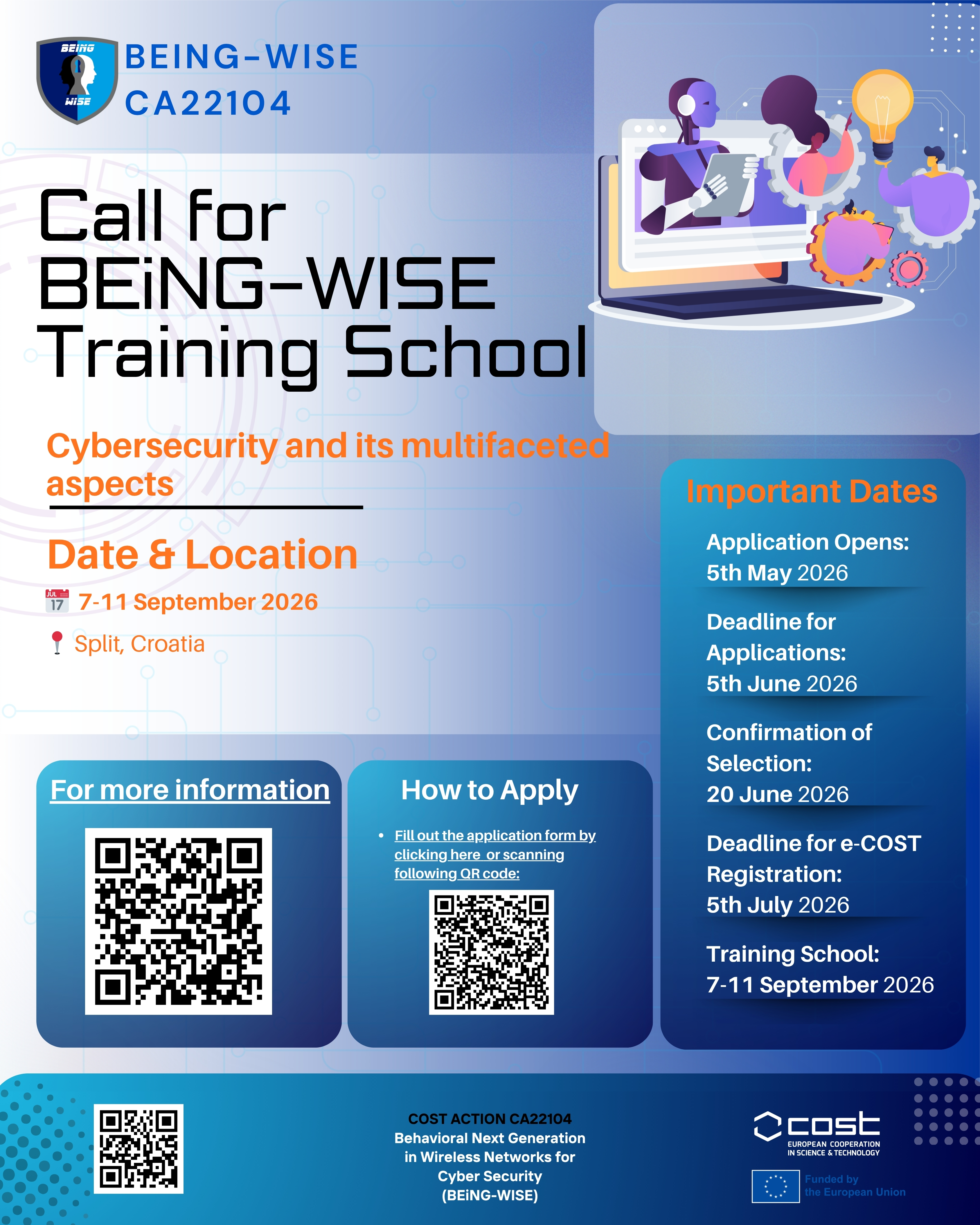
7-11 September 2026
Split, Croatia
Venue: University of Split, Faculty of Economics, Business and Tourism, Cvite Fiskovića 5, 21000 Split, Croatia

Introduction
Cybersecurity has evolved into one of the most critical and complex challenges of the digital era. As societies become increasingly dependent on interconnected digital infrastructures, cloud services, artificial intelligence, and data-driven decision-making, cybersecurity can no longer be treated as a purely technical problem. Instead, it must be understood as a multifaceted domain that spans technology, human behavior, organizational practices, legal frameworks, ethics, and socio-economic contexts. Threats today target not only systems and networks, but also people, institutions, trust, and democratic processes, making cybersecurity a truly interdisciplinary concern.
The growing sophistication of cyber threats—ranging from ransomware and supply-chain attacks to misinformation campaigns, insider threats, and AI-enabled attacks—demands a new generation of cybersecurity professionals and researchers who are capable of thinking beyond traditional defensive mechanisms. Technical excellence remains essential, but it must be complemented by an understanding of human factors, risk perception, governance, compliance, and ethical responsibility. Failures in cybersecurity are often rooted not in the absence of advanced technologies, but in misaligned incentives, poor usability, lack of awareness, inadequate communication, or ethical blind spots in system design and deployment.
At the same time, emerging technologies such as artificial intelligence, machine learning, Internet of Things, and next-generation communication networks are reshaping both the threat landscape and the available defense mechanisms. While these technologies offer unprecedented opportunities to improve detection, automation, and resilience, they also introduce new vulnerabilities, dependencies, and ethical dilemmas. Issues such as algorithmic bias, lack of transparency, data protection, accountability, and trust in automated decision-making have become central to modern cybersecurity discourse.
Against this backdrop, there is a pressing need for structured, high-level training environments that bring together diverse perspectives and expertise. Doctoral candidates, early-career researchers, and young professionals must be exposed to the full spectrum of cybersecurity challenges, learning to navigate the technical, human, industrial, legal, and ethical dimensions in an integrated manner. Training schools play a crucial role in fostering such holistic understanding, offering not only advanced knowledge, but also opportunities for critical reflection, interdisciplinary dialogue, and collaboration.
The training school “Cybersecurity and its Multifaceted Aspects” is conceived as a response to this need. It aims to provide participants with a comprehensive and nuanced understanding of cybersecurity as a socio-technical system, where technology, people, organizations, and policies are deeply intertwined. By combining expert lectures, interactive discussions, case studies, and collaborative activities, the school creates an environment that encourages knowledge exchange, critical thinking, and the development of well-rounded cybersecurity competencies.
Goals of the Training School
The primary goal of the training school is to equip participants with a broad and integrated perspective on cybersecurity, enabling them to understand, analyze, and address cyber risks in their full complexity. Rather than focusing on a single technological domain, the school seeks to highlight the interdependencies between technical solutions and the human, organizational, industrial, and ethical contexts in which they operate.
A key objective is to deepen participants’ understanding of contemporary cybersecurity challenges and emerging threats, while situating these challenges within real-world environments. Participants will be encouraged to critically assess how cyber risks manifest across different sectors, including critical infrastructure, industry, public administration, healthcare, and digital services. Emphasis will be placed on understanding why technically sound security measures may fail in practice, and how human behavior, usability, culture, and governance influence cybersecurity outcomes.
Another important goal is to foster interdisciplinary thinking and collaboration. The training school brings together participants from diverse academic and professional backgrounds, including computer science, engineering, social sciences, law, ethics, and management. By exposing participants to multiple viewpoints and disciplinary approaches, the school aims to break down silos and promote a shared language for discussing cybersecurity problems and solutions. This interdisciplinary exposure is particularly valuable for doctoral researchers whose work increasingly lies at the intersection of multiple domains.
The training school also aims to strengthen participants’ capacity to engage with industrial and societal perspectives on cybersecurity. Understanding how cybersecurity is approached in industry, how risk is managed in complex organizations, and how economic and regulatory constraints shape security decisions is essential for translating research into practice. Through discussions of real-world case studies and industry-driven challenges, participants will gain insights into the practical realities of cybersecurity deployment and governance.
Ethics and responsibility form a central pillar of the school’s goals. Participants will be encouraged to reflect on the ethical implications of cybersecurity technologies and practices, including surveillance, data collection, automated decision-making, and incident response. The school aims to cultivate a strong sense of professional responsibility, emphasizing privacy, human rights, fairness, and accountability as integral components of cybersecurity, rather than optional add-ons.
In addition to knowledge acquisition, the training school seeks to support the professional development of participants. By providing a platform for interaction with leading experts and peers, the school facilitates networking, mentoring, and the exchange of research ideas. Participants will be encouraged to position their own research within the broader cybersecurity landscape, identify potential collaborations, and refine their ability to communicate complex ideas to interdisciplinary audiences.
Ultimately, the goal of the training school “Cybersecurity and its Multifaceted Aspects” is to contribute to the formation of a new generation of cybersecurity experts who are technically competent, critically reflective, ethically grounded, and capable of addressing cyber challenges in a holistic and sustainable manner. By embracing the multifaceted nature of cybersecurity, the school aims to empower participants to make meaningful contributions to research, industry, and society at large.
Training School co-Chairs:
Ivana Bilic, University of Split, Croatia
Ivan Chorbev, Training Coordinator, Ss. Cyril and Methodius University, North Macedonia
Valeria Loscri, BEiNGE-WISE Action Chair, INRIA, France
Call for Trainees
The BEiNG-WISE Training School is a multidisciplinary event open to professionals, researchers, and Ph.D. students with a professional interest in the topic.
Criteria for selected trainees
Applicants shall be engaged in an official research program as a PhD student or postdoctoral fellow or can be employed by, or affiliated to, an institution, organization, or legal entity which has within its remit a clear association with the topics of the COST Action. Moreover, undergraduate and graduate students will be taken into consideration.
Trainees eligible for reimbursement are from COST Full Member Countries, COST Near Neighbor Countries (NNC) or Approved European RTD Organizations.
The selected international applicants (trainees) will benefit from a Trainee Grant to participate in the activities of the Training School @September 7-11, 2026. This grant is expected to cover the long-distance travel expenses (by train, ferry, bus, plane, or car). Furthermore, the international trainees will receive a daily allowance, which is expected to cover the accommodation in Split, meals and local transportation, following the COST annotated rules. Each application will be individually evaluated along with the total grant awarded for the 5 days.
The selected applicants (trainees) from Croatia will benefit from a Trainee Grant to participate in the activities of the Training School based on the distance to and from Split and the accommodation needs. This grant will be individually discussed and agreed.
Selected trainees shall create an e-COST profile at https://e-services.cost.eu including bank details prior to accepting their e-COST invitation. They shall submit via e-COST a completed online travel reimbursement request within 30 calendar days after the end date of the approved activity.
Training topics
We are excited that you are part of this program and at the opportunities it will provide to you!
The training will revolve around the following topics:
Foundations of Modern Cybersecurity
This topic provides a structured overview of the contemporary cybersecurity landscape, including threat models, attack vectors, and defense strategies across digital infrastructures. Participants will explore how cybersecurity has evolved from perimeter-based protection to risk-driven, resilience-oriented approaches that address complex, interconnected systems.
Human Factors and Usability in Cybersecurity
Focusing on the role of human behavior in security incidents, this topic examines how users, administrators, and decision-makers interact with security technologies. It addresses issues such as social engineering, insider threats, security awareness, and usability, highlighting how human-centered design can significantly improve security outcomes.
Cybersecurity in Industrial and Critical Infrastructures
This topic explores cybersecurity challenges in industrial environments, including critical infrastructure, operational technology (OT), and cyber-physical systems. Participants will learn about sector-specific risks, legacy systems, safety-security interactions, and incident response in high-impact environments where failures can have societal consequences.
AI and Data-Driven Approaches in Cybersecurity
Participants will examine how artificial intelligence and machine learning are used to support cybersecurity tasks such as threat detection, anomaly detection, and incident response. The topic also addresses limitations, risks, and trust issues related to AI-based security solutions, emphasizing the need for transparency, robustness, and responsible deployment.
Privacy, Ethics, and Responsible Cybersecurity
This topic introduces ethical principles and privacy considerations relevant to cybersecurity practice and research. It covers topics such as data protection, surveillance, proportionality, bias, accountability, and the societal impact of security technologies, encouraging participants to integrate ethical reasoning into technical decision-making.
Governance, Regulation, and Cyber Risk Management
Participants will explore how cybersecurity is shaped by legal frameworks, standards, and organizational governance structures. The topic covers risk assessment, compliance, policy development, and regulatory instruments, helping participants understand how technical solutions align with legal and organizational requirements.
Cybersecurity Incident Response and Crisis Management
This topic focuses on preparing for, managing, and recovering from cybersecurity incidents. Participants will learn about incident response planning, coordination between technical and non-technical stakeholders, communication strategies, and post-incident analysis, with an emphasis on resilience and organizational learning.
Emerging Threats and Future Directions in Cybersecurity
The final topic looks ahead to emerging trends and challenges, including supply-chain attacks, AI-enabled threats, misinformation campaigns, and security implications of future digital infrastructures. Participants will be encouraged to critically assess future risks and identify research and innovation directions in cybersecurity.
Discussion
Cybersecurity today represents far more than a purely technical challenge; it is a complex socio-technical domain shaped by human behavior, organizational practices, ethical considerations, regulatory frameworks, and rapidly evolving technologies. The training school “Cybersecurity and its Multifaceted Aspects” is conceived as a response to this complexity, offering participants a comprehensive space to critically reflect on how these dimensions intersect and influence one another. By moving beyond narrow, technology-centric perspectives, the school emphasizes the need for integrated approaches that acknowledge cybersecurity as a systemic and societal concern.
Throughout the training school, participants are encouraged to examine how technical solutions interact with human users and organizational environments. Security failures often emerge not from the absence of advanced technologies, but from misaligned incentives, usability challenges, lack of awareness, or inadequate governance structures. Addressing these issues requires interdisciplinary thinking that combines engineering excellence with insights from psychology, ethics, law, and management. This holistic perspective is essential for designing cybersecurity solutions that are not only effective, but also usable, trustworthy, and sustainable in real-world contexts.
The discussion also highlights the growing influence of data-driven and automated approaches in cybersecurity, including the use of artificial intelligence and advanced analytics. While these technologies offer significant potential for enhancing detection, response, and resilience, they also raise important questions regarding transparency, accountability, bias, and human oversight. The training school therefore places strong emphasis on critical evaluation, encouraging participants to assess both the capabilities and the limitations of emerging tools, and to consider their broader implications for individuals, organizations, and society.
Equally important is the industrial and policy dimension of cybersecurity. Participants are exposed to the realities of securing complex systems in sectors such as critical infrastructure, industrial environments, and large-scale digital platforms. These settings require balancing security with safety, productivity, legal compliance, and ethical responsibility. By engaging with practical case studies and real-world scenarios, the school fosters an appreciation of how cybersecurity decisions are made under constraints and uncertainty, and how research outcomes can be translated into actionable strategies.
In conclusion, the training school serves as a platform for knowledge exchange, critical debate, and capacity building across disciplines and sectors. It aims to empower participants with the conceptual tools and reflective skills needed to address cybersecurity challenges in a responsible and informed manner. By fostering dialogue between technical, human, ethical, and governance perspectives, the school contributes to the development of a new generation of researchers and professionals capable of shaping secure, resilient, and socially aligned digital futures.
Key dates
- Applications opened: May 5, 2026
- Applications submission deadline: June 5, 2026
- Confirmation to the selected trainees: June 20, 2026
- Deadline for e-COST registration and confirmation: July 5, 2026
- Training School days: September 7-11, 2026