
Training school:
CyberEM – Cybercrime from the techno to the crime
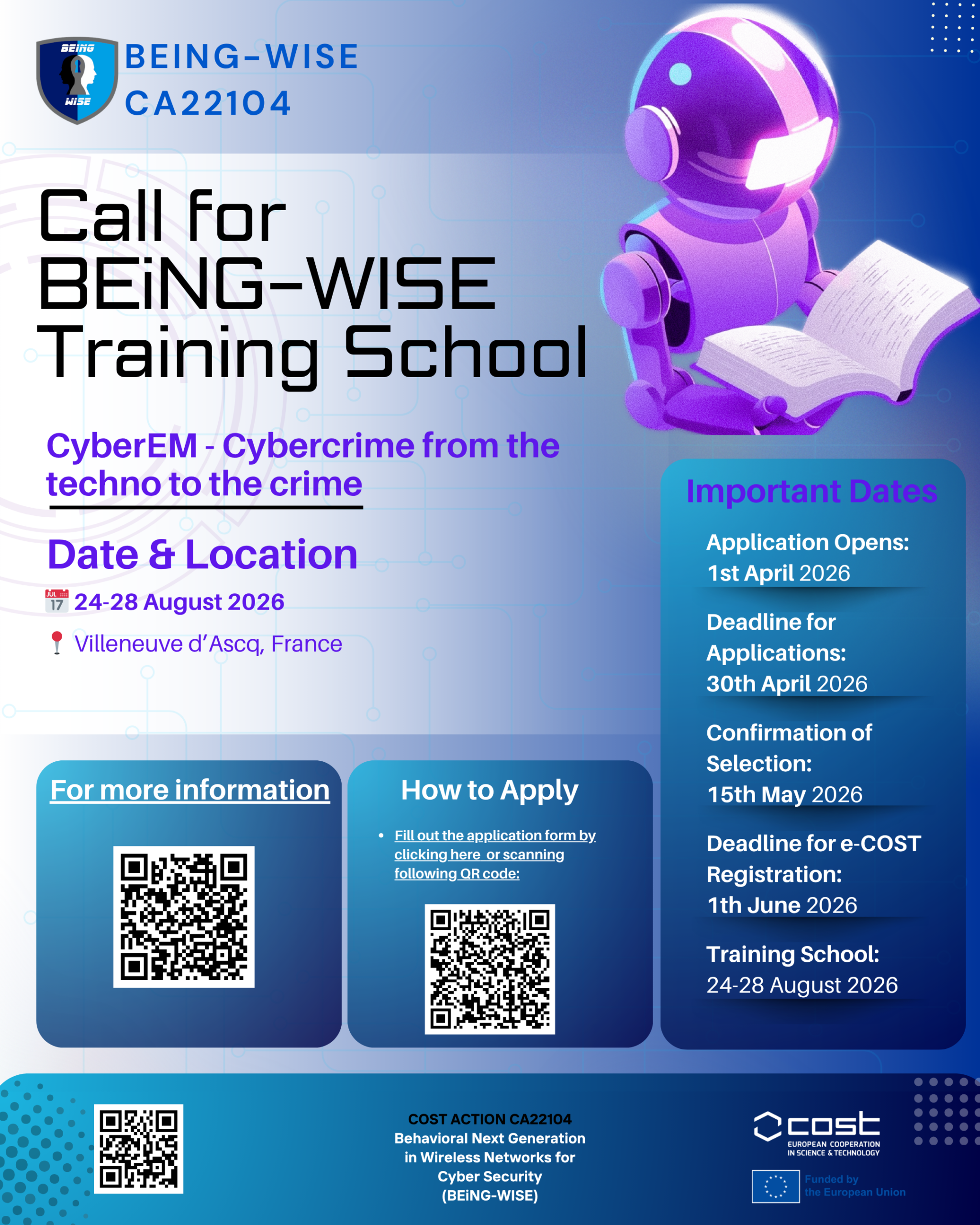
24-28 August 2026
Villeneuve d’Ascq, France
Venue: University Gustave Eiffel, 20 rue Elisee Reclus, 59650, Villeneuve d’Ascq, France

Introduction
The COST Action CA22104 BEiNG-WISE, is pleased in launching the CALL for trainees for the Training School titled: CyberEM – Cybercrime from the techno to the crime.
The rapid evolution of wireless communication technologies has profoundly transformed modern society, enabling unprecedented levels of connectivity across personal, industrial, and critical systems. From legacy cellular networks to next-generation wireless infrastructures, these technologies form the backbone of digital services, smart environments, and data-driven economies. At the same time, their widespread adoption and increasing complexity have made wireless systems a prime target for cybercriminal activities. Attacks exploiting vulnerabilities in communication protocols now represent a significant and growing threat, with consequences ranging from privacy breaches to service disruption and physical-world impact.
The training school CyberEM – Cybercrime: From the Techno to the Crime is designed to bridge the gap between theoretical knowledge of wireless communication systems and the practical realities of cybercrime. Rather than addressing cybersecurity at an abstract level, this school adopts a concrete, hands-on approach that allows participants to understand how technical vulnerabilities can be exploited in practice and how such exploits translate into real-world threats. By combining high-level theoretical instruction with laboratory-based experimentation, the school provides a unique learning environment in which participants can directly observe the link between protocol design, system behavior, and cybercriminal techniques.
A key distinguishing feature of the training school is its focus on wireless technologies across multiple generations and application domains. Participants will explore a broad range of communication protocols, including cellular networks from 2G to 5G, Wi-Fi technologies, and low-power wide-area networks such as LoRa. This wide technological scope reflects the diversity of contemporary attack surfaces and enables participants to develop a comprehensive understanding of both legacy and emerging wireless security challenges. Through guided experimentation and supervised use of wireless hacking tools, students will gain insight into how attacks affect systems not only at the logical and network layers, but also at the physical level.
By exposing participants to realistic attack scenarios in a controlled academic environment, CyberEM aims to demystify cybercrime in wireless systems and foster critical thinking about security-by-design, resilience, and responsible use of technology. The school encourages participants to approach cybersecurity from an informed and ethical standpoint, emphasizing awareness, prevention, and mitigation rather than misuse.
Goal
The primary goal of the CyberEM training school is to advance the technical preparation of students in the field of wireless cybersecurity by providing them with a deep, experiential understanding of how cyberattacks are carried out against communication technologies. Through direct interaction with real equipment and protocols, participants will move beyond theoretical models and gain practical skills that are essential for both research and professional practice in cybersecurity.
A central objective is to enable participants to identify and analyze vulnerabilities in wireless communication systems and to understand how these weaknesses can be exploited by malicious actors. By performing selected attacks themselves under expert supervision, students will be able to observe the immediate and downstream effects of cybercrime at the physical, protocol, and system levels. This experiential learning approach strengthens analytical capabilities and enhances the ability to anticipate, detect, and mitigate real-world threats.
Another key goal is to increase awareness of the risks associated with modern communication technologies. As wireless systems are increasingly embedded in everyday life and critical infrastructures, understanding their security limitations is essential for responsible design, deployment, and regulation. The training school aims to cultivate a security-aware mindset, helping participants recognize how design choices, configuration practices, and technological constraints can influence exposure to cybercrime.
Finally, the school seeks to foster a strong connection between technical expertise and cybersecurity responsibility. By contextualizing attacks within the broader framework of cybercrime, the training encourages participants to reflect on ethical boundaries, legal implications, and the societal impact of wireless security failures. Upon completion of the training school, participants will be better equipped to contribute to the development of more secure wireless systems and to engage professionally with cybersecurity challenges from both a technical and an informed, responsible perspective.
There are several main specific objectives of BEiNG-WISE COST Action and the Training School:
- Promote Interdisciplinary Collaboration: Encourage interdisciplinary collaboration among participants from diverse backgrounds, including doctoral students, researchers, policymakers, and industry professionals. By fostering collaboration, the training program aims to facilitate knowledge exchange, foster innovative thinking, and inspire cross-sector partnerships.
- Develop Analytical and Critical Thinking Skills: Enhance participants’ analytical and critical thinking skills by engaging them in discussions, case studies, and interactive sessions. The program aims to empower participants to evaluate the social, economic, ethical, and policy dimensions of cybersecurity and develop informed perspectives.
- Equip Participants with Practical Knowledge and Tools: Provide participants with practical knowledge and tools that enable them to navigate the complex landscape of cybersecurity in wireless networks. This includes understanding policy frameworks, leveraging emerging technologies, and developing skills and capabilities relevant to the digital era.
- Facilitate Networking and Collaboration Opportunities: Create a conducive environment for networking and collaboration among participants, guest speakers, and experts in the field. The program intends to foster connections leading to future research collaborations, joint projects, and professional development opportunities in the digitalization domain.
By achieving these goals, the training school aspires to empower participants to become well-rounded scholars and practitioners who can contribute to advancing policies, technologies, and challenges for cybersecurity in wireless networks.
Training School co-Chairs:
Virginie Deniau, University Gustave Eiffel, France
Christophe Gransart, University Gustave Eiffel, France
Ivan Chorbev, Training Coordinator, Ss. Cyril and Methodius University, North Macedonia
Valeria Loscri, BEiNGE-WISE Action Chair, INRIA, France
Call for Trainees
The BEiNG-WISE Training School is a multidisciplinary event open to professionals, researchers, and Ph.D. students with a professional interest in the topic.
Criteria for selected trainees
Applicants shall be engaged in an official research program as a PhD student or postdoctoral fellow or can be employed by, or affiliated to, an institution, organization, or legal entity which has within its remit a clear association with the topics of the COST Action. Moreover, undergraduate and graduate students will be taken into consideration.
Trainees eligible for reimbursement are from COST Full Member Countries, COST Near Neighbor Countries (NNC) or Approved European RTD Organizations.
The selected international applicants (trainees) will benefit from a Trainee Grant to participate in the activities of the Training School @August 24-28, 2026. This grant is expected to cover the long-distance travel expenses (by train, ferry, bus, plane, or car). Furthermore, the international trainees will receive a daily allowance, which is expected to cover the accommodation in Villeneuve d’Ascq, meals and local transportation. Each application will be individually evaluated along with the total grant awarded for the 5 days.
The selected applicants (trainees) from France will benefit from a Trainee Grant to participate in the activities of the Training School based on the distance to and from Villeneuve d’Ascq and the accommodation needs. This grant will be individually discussed and agreed.
Selected trainees shall create an e-COST profile at https://e-services.cost.eu including bank details prior to accepting their e-COST invitation. They shall submit via e-COST a completed online travel reimbursement request within 30 calendar days after the end date of the approved activity.
Training topics
We are excited that you are part of this program and at the opportunities it will provide to you!
The training will revolve around the following topics:
Fundamentals of Wireless Communication Systems
This topic introduces the core principles of wireless communications that underpin modern networks. Participants will revisit essential concepts such as modulation, coding, channel access, spectrum usage, and protocol layering, providing a common technical foundation. Emphasis is placed on understanding how design choices at the physical and MAC layers influence security properties and attack surfaces.
Wireless Security Architectures and Threat Models
Participants will explore the security mechanisms embedded in wireless communication standards, including authentication, encryption, key management, and access control. The topic examines common threat models in wireless environments and explains how attackers exploit protocol weaknesses, misconfigurations, and legacy features. Real-world examples will be used to link abstract threats to concrete attack scenarios.
Cybercrime Techniques in Cellular Networks (2G–5G)
This topic focuses on attacks targeting cellular communication systems across multiple generations. Participants will analyze vulnerabilities in legacy protocols and examine how backward compatibility, signaling procedures, and mobility management introduce security risks. Practical sessions will demonstrate attacks such as interception, impersonation, tracking, and denial of service in controlled laboratory settings.
Wi-Fi Security and Practical Attacks
Covering IEEE 802.11 technologies, this topic addresses Wi-Fi security mechanisms and their weaknesses. Participants will study authentication and encryption schemes, rogue access points, and man-in-the-middle attacks. Hands-on laboratory exercises will allow students to perform selected attacks using wireless hacking tools and to observe their impact on network performance and user privacy.
Low-Power and IoT Wireless Technologies: LoRa and Beyond
This topic examines the security challenges of low-power wide-area networks used in IoT deployments. Participants will explore protocol design trade-offs related to energy efficiency, scalability, and security, and analyze vulnerabilities specific to technologies such as LoRa. Practical demonstrations will highlight how attacks can affect device integrity, data confidentiality, and system reliability.
Physical Layer Attacks and Radio Signal Manipulation
Focusing on the physical layer, this topic introduces attacks that exploit radio signal properties rather than higher-layer protocols. Participants will learn about jamming, replay attacks, and signal spoofing, and will observe how these attacks manifest at the physical level. The topic emphasizes the often-overlooked link between radio engineering and cybersecurity.
Wireless Hacking Tools and Experimental Methodologies
This topic familiarizes participants with commonly used wireless security analysis and hacking tools. Students will learn how to safely configure and use these tools in laboratory environments, interpret results, and document experiments. Strong emphasis is placed on responsible use, reproducibility, and ethical boundaries in experimental cybersecurity research.
From Technical Vulnerabilities to Cybercrime Impact
The final topic connects technical attacks to their broader implications. Participants will analyze how wireless attacks translate into cybercrime, considering impacts on users, organizations, and critical services. Discussions will include privacy violations, service disruption, economic damage, and legal consequences, reinforcing the importance of secure design and informed risk assessment.
Discussion
The CyberEM – Cybercrime: From the Techno to the Crime training school is designed to provide participants with a realistic and in-depth understanding of how vulnerabilities in wireless communication technologies can be exploited and transformed into concrete cybercriminal activities. By combining solid theoretical foundations with extensive hands-on experimentation, the school moves beyond abstract discussions of cybersecurity and exposes participants to the practical mechanisms through which attacks occur and propagate in real systems.
A key strength of the training school lies in its emphasis on learning through direct observation and experimentation. Allowing participants to perform selected attacks in a controlled laboratory environment enables them to clearly perceive the relationship between protocol design, system behavior, and security weaknesses. Observing the physical and operational impact of attacks on wireless systems—rather than only their logical consequences—deepens technical understanding and fosters critical thinking about the limitations of existing security mechanisms.
The broad coverage of wireless technologies, ranging from legacy cellular systems to modern 5G networks, Wi-Fi, and low-power IoT communications, reflects the diverse and evolving nature of today’s attack surfaces. This comprehensive scope helps participants appreciate how design trade-offs, backward compatibility, and deployment constraints can introduce vulnerabilities that persist across generations of communication standards. Through this exposure, participants develop a more informed perspective on how technological evolution shapes both defensive strategies and cybercrime opportunities.
Beyond technical skills, the training school reinforces awareness of the broader implications of wireless cyberattacks. By framing technical vulnerabilities within the context of cybercrime, participants are encouraged to consider the societal, economic, and legal consequences of insecure communication systems. This perspective supports the development of responsible cybersecurity professionals and researchers who understand not only how attacks are carried out, but also why prevention, mitigation, and ethical conduct are essential.
In conclusion, CyberEM provides a comprehensive and balanced learning experience that strengthens technical expertise while promoting security awareness and responsibility. The training school equips participants with the knowledge and practical insight needed to analyze wireless threats, contribute to more secure system design, and engage effectively with cybersecurity challenges at the intersection of technology and cybercrime.
Key dates
- Applications opened: April 1, 2026
- Applications submission deadline: April 30, 2026
- Confirmation to the selected trainees: May 15, 2026
- Deadline for e-COST registration and confirmation: June 1, 2026
- Training School days: August 24-28, 2026